Circadian Rhythms
Many of the hormones in the body maintain a roughly 24-hour rhythm, controlled by the suprachiasmatic nucleus (SCN)—also known as the body clock—in the hypothalamus. The HPA axis — the body's stress/energy regulator — is one of the most important circadian rhythms in the body. As well as regulating cortisol levels, it has such a great influence over health and vitality, being an important modulator of the immune system, energy regulation, the digestive system and reproductive system.
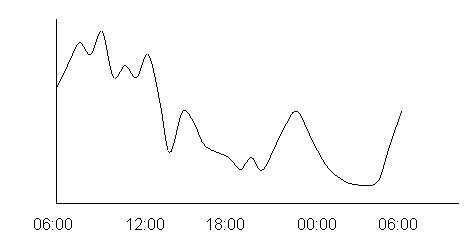
Figure: Typical variation in cortisol levels throughout the day in a healthy individual
In healthy individuals, cortisol has a diurnal variation, rising in the 30-60 minutes after awakening, then dipping, followed by another peak in the late afternoon.
Different systems in the body have their own body clocks, such as the digestive system and core body temperature. These circadian rhythms are reset by the "master" body clock (the SCN). The SCN is regulated by sunlight entering the retina, and also by physical activity.
Activity is also important in regulating sleep: during the day, mental and physical activity result in ATP breaking down into byproducts including adenosine. Adenosine then causes a need for sleep ("sleep pressure") to build up. Activity and exercise, therefore, help to regulate and promote sleep, so an abnormally low activity pattern may disrupt sleep due to low levels of adenosine.
Abnormal hormone rhythms have been implicated in chronic fatigue syndrome (CFS), seasonal affective disorder (SAD) and insomnia. Research shows that CFS patients tend to have a less pronounced (more flat) circadian rhythm of HPA axis activation, and that the patients who recover most tend to have the greatest increase in circadian hormone variation (peak to trough). Two studies have shown that morning cortisol in CFS patients is improved after treatment with CBT.
Research also shows that high levels of exercise causes the circadian rhythm to shift in CFS patients, causing their sleep-wake cycle to get later, but not in controls.
Having a circadian rhythm rather than a constant level of certain hormones, such as cortisol and melatonin, is important to many systems in the body, and the abolition of the normal rhythm is likely to cause many of the symptoms associated with illnesses such as CFS. A dysregulated body clock significantly affects sleep, and insomnia has been shown to exacerbate CFS symptoms.
A common symptom of CFS is hypersensitivity to noise, and this may be due to altered circadian rhythm. It has been shown that the cochlea in the inner ear has its own circadian rhythm that is controlled by the SCN master body clock. Animal experiments have shown that there is a greater sensitivity to sound at night. Therefore a disrupted body clock could result in increased sensitivity to sound during the day.
Studies on mice have shown that chronic stress results in significantly reduced amplitude of the SCN master body clock, as well as reduced body temperature variation between day and night, and depressive symptoms. Similar changes have been seen in SCN activity in human patients suffering from major depression.
References and external links
How Adenosine Affects SleepPapadopoulos, Andrew S., and Anthony J. Cleare. "Hypothalamic-pituitary-adrenal axis dysfunction in chronic fatigue syndrome." Nature Reviews Endocrinology 8.1 (2012): 22-32.
Tanaka, M., Tajima, S., Mizuno, K., Ishii, A., Konishi, Y., Miike, T., & Watanabe, Y. (2015). Frontier studies on fatigue, autonomic nerve dysfunction, and sleep-rhythm disorder. The Journal of Physiological Sciences, 65(6), 483-498.
Sanne L.Nijhof et al. 2014. The role of hypocortisolism in chronic fatigue syndrome. Psychoneuroendocrinology.
Amanda D.L.Roberts et al. 2009. Salivary cortisol output before and after cognitive behavioural therapy for chronic fatigue syndrome. Journal of Affective Disorders.
Jung-sub Park et al. 2016. Identification of a Circadian Clock in the Inferior Colliculus and Its Dysregulation by Noise Exposure. Journal of Neuroscience.
Kinoshita, C., Miyazaki, K., & Ishida, N. (2012). Chronic stress affects PERIOD2 expression through glycogen synthase kinase-3β phosphorylation in the central clock. Neuroreport, 23(2), 98-102.
Logan, R. W., Edgar, N., Gillman, A. G., Hoffman, D., Zhu, X., & McClung, C. A. (2015). Chronic stress induces brain region-specific alterations of molecular rhythms that correlate with depression-like behavior in mice. Biological psychiatry, 78(4), 249-258.
Harrington, M. E. (2012). Exercise strengthens circadian clocks. The Journal of physiology, 590(Pt 23), 5929.
Wikipedia page on circadian rhythm
Copyright (c) Mind-Body-Health.net, All Rights Reserved
DISCLAIMER: Mind-Body-Health.net is an educational resource for chronic fatigue syndrome (CFS), myalgic encephalomyelitis (ME), burnout and related disorders, and is not giving medical advice. Seek advice from a medical practitioner before making any changes to your life, or if you experience worsening symptoms. CFS is a diagnosis of exclusion, so it is important to rule out other causes for illness.