Burnout
The burnout syndrome is a set of physical and mental symptoms including:
- exhaustion/fatigue
- headaches
- depression
- anxiety
- insomnia, excessive sleeping and/or dysregulated body clock
- chronic pain
- loss of appetite and/or difficulty digesting food (including slow stomach emptying)
- IBS symptoms such as constipation and diarrhea
- difficulty regulating temperature, feeling very cold without having a fever, and night sweats
- abnormal hormone levels (including thyroid, cortisol and testosterone)
- suppressed or altered immunity, including susceptibility to viral infections and increased allergic symptoms
The job-demands model of burnout shows that burnout is associated with high job demands (e.g. pressure at work) and low job resources (e.g. being in control and having a variety of tasks). Research has shown that job demands correspond to feelings of exhaustion in burnout out workers.
A study on teachers suffering from burnout found that those teachers who scored highest on the "Maslach Burnout Inventory" had the lowest levels of cortisol (the main stress hormone released by the adrenal glands) throughout the day. The teachers who said they were under stress but not suffering from burnout had the highest levels of cortisol. The study also found that those teachers who were highest on the burnout scales had the highest levels of physical illness complaints. The stress level did not alter the number of physical complaints among the teachers who were low on the scale. The factors associated with high levels of burnout were low job satisfaction, low perceived levels of support, low perceived levels of being able to cope with stress and high levels of emotional exhaustion (although this last one could be a symptom rather than a cause).
This study highlights a number of important findings. First of all, that mental attitude has a large influence over the ability to handle stress without suffering from burnout. Second, that people suffering from burnout have higher levels of physical illness complaints. And third, that low levels of cortisol (and a suppressed HPA axis) seem to be associated with low stress tolerance and high levels of burnout.
This particular study also found that stress and burnout are separate variables, i.e. people can suffer from burnout in the absence of stress, and vice-versa.
Many studies have confirmed that hypocortisolism is associated with burnout, CFS, fibromyalgia, and childhood abuse victims.
Causes of burnout
Burnout appears to be caused by excessive long-term psychological/physical stress and emotional arousal. It is most common in service professions such as nursing and teaching, and in jobs that involve a lot of customer relationships where emotions may need to be suppressed. The depersonalisation aspect of burnout may be a protection mechanism designed to protect against the effects of excessive emotional arousal, by treating the other party as an object rather than a person.
Stress hormones and burnout
Popular belief is that burnout is the result of excessive stress. This is the view that Hans Selye took when he presented his General Adaptation Syndrome theory of stress, which has the following three stages:
[1] The alarm phase at the onset of the stress, which causes the adrenal
cortex to discharge all of its supply of stored hormones into the
blood.
[2] The stage of resistance, where the adrenal cortex enlarges due
to continued stimulation by ACTH, which results in an enhanced ability to
manufacture and secrete higher levels of cortisol. During this stage
there is a greater ability to deal with stress.
[3] The stage of exhaustion, which eventually comes after continued
stress, and results in symptoms similar to the alarm phase. During this
phase the adrenal glands shrink and levels of cortisol fall, resulting
in an inability to cope with stress.
From his results, Selye proposed that many illnesses in humans which are not obviously caused by an external pathogen, such as liver disease and heart disease, may be due to the psychological stresses of modern life. He proposed that the continual stresses of modern life result in the exhaustion phase of the GAS, which then leads to one of any number of physical illnesses. This notion has been mostly rejected today due to the advances in understanding about how the body works, with a greater concentration on the underlying mechanism of disease. In fact, most of Selye's work seems to have been forgotten today, and his GAS has largely been rejected. While it is true that he tried to apply his theories too broadly, there is one very important fact which he discovered and which is largely ignored today, and that is the exhaustion phase of the GAS, which appears to correspond with the state of burnout.
Even though early research pointed to a low cortisol state resulting from excessive stress, this research languished for 10-15 years due to the prevailing wisdom that stress was always associated with high cortisol. However, during recent decades, research has clearly shown that long-term stress can be associated with low cortisol and suppressed HPA axis activation, and this state of low cortisol is associated with CFS, PTSD and burnout. Whether or not the stress causes hypocortisolism depends on the nature of the threat, the time since onset, and the person's response to the situation.
Fries et al hypothesize that the hypocortisolism seen in stress-related disorders such as CFS, burnout and PTSD is actually a protective mechanism which has evolved to conserve energy during threats that are beyond the organism's ability to cope. When it appears that it may not be beneficial to continue with the stressful activity, the brain might have evolved a method of shutting down the HPA axis to prevent unnecessary expenditure of energy and protect the body from the damage caused by a long-term stress response.
Autonomic Nervous System
The autonomic nervous system (ANS) consists of two branches: the sympathetic and the parasympathetic. The sympathetic nervous system is activated during any type of physical or mental stress. Effects include: increasing heart rate and blood pressure, reducing heart rate variability (so that heart rate doesn't vary much from beat to beat), inhibiting digestion, and diverting blood from the extremities. The parasympathetic nervous system has the opposite effect: reducing heart rate, increasing heart rate variability, and facilitating digestion. The two branches of the ANS are complementary: when sympathetic activation is high, parasympathetic nervous activation is reduced, and vice versa. Typically the sympathetic nervous system is activated during stress, and the parasympathetic nervous system is more active during the recovery phase after the stress.
Japanese researchers have found that CFS patients tend to have reduced parasympathetic activity, and increased sympathetic activity. They also found that the same ANS dysfunction is seen in healthy people after engaging in an acutely fatiguing task, and the lack of parasympathetic activity appears to correlate to feelings of fatigue. The difference is that in CFS the ANS dysfunction happens after much lower levels of stress or activity. Similar ANS dysfunction is seen in burnout and Gulf war syndrome.
The ANS dysfunction seen in burnout and CFS can cause orthostatic intolerance, resulting in dizziness, fainting and low blood pressure on standing up, along with dysfunction of the gastrointestinal, urinary, temperature regulation, bowel function, metabolic and hormone systems.
More research is needed to understand what causes the ANS dysfunction. It may be that the normal "brake" on sympathetic activation in the prefrontal cortex isn't working properly, so that the sympathetic nervous system is always hyperactive, resulting in reduced parasympathetic activation. Alternatively it may be that there is reduced parasympathetic drive due to fatigue, and the increased sympathetic activation is compensatory.
Heart rate variability
Heart rate variability refers to beat-to-beat changes in the length of the heartbeat timing. The vagus nerve of the parasympathetic nervous system controls this beat-to-beat timing of the heart rhythm, so measuring the small changes in heart rate can give an estimate of parasympathetic nervous system activity.
The interesting thing about HRV is that it tends to inversely correlate with any type of stressor. At the start of an illness such as a cold, HRV will reduce a few days before any symptoms become apparent. HRV is also reduced when there are any psychological stressors, or when there is excessive exercise with too little rest.
Athletes use HRV measurements to adjust their training schedule to avoid
overtraining. When there are too many stresses on the body, HRV tends to
drop fairly quickly, and tends to keep dropping day-by-day while those stressors are still present.
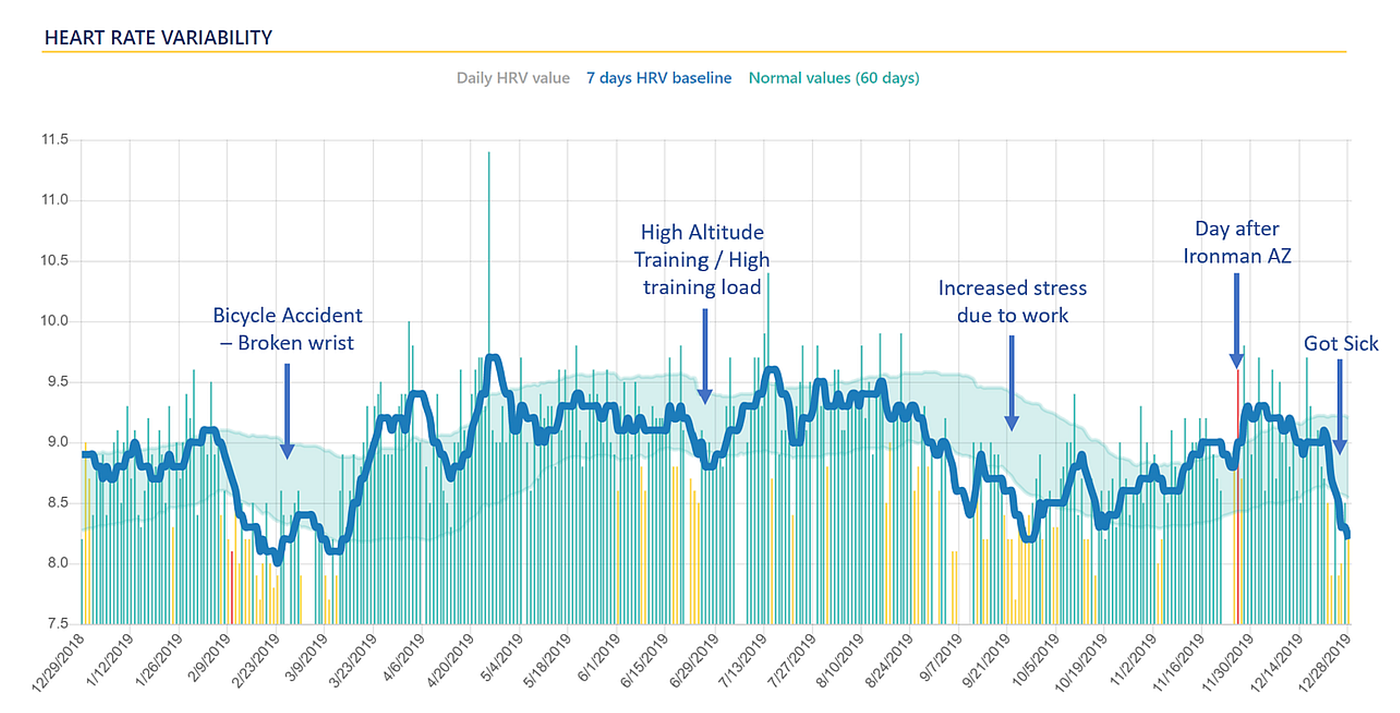
(From The Ultimate Guide to Heart Rate Variability by Marco Altini
HRV is best measured either during sleep or first thing in the morning, as it tends to be affected by eating, exercise and other activities during the day.
Patients with CFS tend to have higher heart rate and lower HRV during sleep than healthy controls with a similar activity level, and HRV biofeedback has been shown to improve fatigue, quality of life and depression in CFS.
Adrenal fatigue
The term "adrenal fatigue" was coined by James Wilson to describe the hypoadrenalism seen during chronic stress. Wilson proposes that the adrenal glands become worn out after excessive long-term stress and lose their ability to produce cortisol. However that does not fit the science. Although one study found that some CFS patients have shrunken adrenal glands, most patients have normal adrenal glands which produce normal amounts of cortisol. Research instead shows that CFS patients have an abnormally low HPA axis response to stress, as well as an abnormally low cortisol awakening response (which itself is thought to be a good indication of HPA axis responsiveness, as waking up is essentially a mild stressor for the HPA axis). All the research shows that the hypocortisolism is central in nature, i.e. controlled by the brain, rather than any problem with the adrenal glands themselves.
The Central Governor — fatigue is a brain-derived emotion
Sports science research by Tim Noakes and other researchers has shown that fatigue is actually an emotion generated in the brain, which acts to prevent damage to the body when the brain perceives that further exertion could be harmful.
Research has shown that fatigue in sports is largely independent of the state of the muscles themselves (which normally only reach 60% of capacity during maximum exercise). A large number of factors have been shown to cause fatigue in athletes, such as core temperature, glycogen levels, oxygen levels in the brain, thirst, rate of heat accumulation, sleep deprivation, and levels of muscle soreness/fatigue. Psychological factors such as emotional state, knowledge of the endpoint, other competitors, motivation, visual feedback, placebos/nocebos, as well as psychological skills training have also shown to modify athletic performance.
The brain appears to have a "central governor" which puts together all of these physical and psychological factors in order to generate the experience of fatigue, in order to protect the body from potential damage or death due to over-exertion.
Even though the word "emotion" is used, fatigue is somewhat different to other emotions in that it directly affects the motor cortex, resulting in great difficulty in the ability to consciously override it. (In fact it may not be a good idea to override fatigue in the long-term, as that may lead to overtraining syndrome).
Overtraining syndrome
Athletes who train excessively can sometimes suffer from overtraining syndrome, with symptoms similar to CFS, as well as similar HPA axis hypofunction. Overtraining appears to be the result of excessive training with too little rest over a long period of time, and is thought to be the result of a combination of physical and psychological stress. It is a particular problem in ultramarathon runners.
Mental fatigue: unconscious cost-benefit analysis
Research on animals has uncovered what appears to be a unconscious "cost-benefit analysis" within the brain, which determines whether an activity is likely to be worth the effort of expending energy. Activity will only proceed if the benefits outweigh the expenditure in energy. The parts of the brain which appear to be behind this "cost-benefit analysis" are the dopaminergic systems, which are involved in reward and goal processing in the brain.
Boksem suggests that this dopaminergic system is behind feelings of mental fatigue, and that overriding the signals from this system for a prolonged period of time results in long-term fatigue, burnout and chronic fatigue.
In the brain, or due to hormones?
Research suggests that both the the brain, and the HPA axis, may be responsible for the fatigue experienced during burnout and CFS. Due to the fact that cortisol levels are quite often normal in CFS, it could be that the abnormalities in the HPA axis are simply a downstream consequence of the brain shutting off activity. This fatigue "shutdown" would then affect the motor cortex directly, resulting in great difficulty in overriding the fatigue, as well as secondarily via the HPA axis and autonomic nervous system (which are also regulated by the same parts of the brain).
Relationship to CFS
Burnout and CFS may initially appear to be very different, but closer investigation shows that they are in fact quite similar. The same hormonal abnormalities appear in both groups, namely reduced cortisol and a suppressed HPA axis, as well as similar physical illness complaints.
Also, a significant proportion of CFS patients say that their illness began during a period of high stress. In some cases this was emotional stress, but in other cases it was simply a high-pressure job (which in many cases the person did not find "stressful" in the negative sense).
In fact, all of the known triggers for CFS, such as emotional stress, negative mental attitude, viral infection, and working in a high-pressure job, are the same factors which cause burnout. CFS can best be thought of as a state of long-term burnout which persists even after the initial stressors have been removed.
For further details, see the chronic fatigue syndrome section.
Recovery
See the recovery section.
References and external links
Wikipedia page on occupational burnoutPruessner JC, Hellhammer DH, Kirschbaum C, "Burnout, perceived stress, and cortisol responses to awakening", Psychosomatic Medicine 1999;61:197-204
Morgan CA 3rd, Cho T, Hazlett G, Coric V, Morgan J, "The impact of burnout on human physiology and on operational performance: a prospective study of soldiers enrolled in the combat diver qualification course", Yale J Biol Med. 2002 Jul-Aug;75(4):199-205
Leone, S. S., Wessely, S., Huibers, M. J., Knottnerus, J. A., & Kant, I. (2011). "Two sides of the same coin? On the history and phenomenology of chronic fatigue and burnout." Psychology and Health, 26(4), 449-464.
Huibers, M. J. H., Beurskens, A. J. H. M., Prins, J. B., Kant, I. J., Bazelmans, E., Van Schayck, C. P., ... & Bleijenberg, G. (2003). "Fatigue, burnout, and chronic fatigue syndrome among employees on sick leave: do attributions make the difference?" Occupational and environmental medicine, 60(suppl 1), i26-i31.
Fries, E., Hesse, J., Hellhammer, J., & Hellhammer, D. H. (2005). "A new view on hypocortisolism." Psychoneuroendocrinology, 30(10), 1010-1016.
Miller, G. E., Chen, E., & Zhou, E. S. (2007). "If it goes up, must it come down? Chronic stress and the hypothalamic-pituitary-adrenocortical axis in humans." Psychological bulletin, 133(1), 25.
Charmandari, E., Tsigos, C., & Chrousos, G. (2005). "Endocrinology of the stress response" 1. Annu. Rev. Physiol., 67, 259-284.
Demerouti, E., Bakker, A. B., Nachreiner, F., & Schaufeli, W. B. (2001). The job demands-resources model of burnout. Journal of Applied psychology, 86(3), 499.
Edwards, L. D., Heyman, A. H., & Swidan, S. (2011). Hypocortisolism: an evidence-based review. Integrative Medicine, 10(4), 30.
Angeli, A., Minetto, M., Dovio, A., & Paccotti, P. (2004). The overtraining syndrome in athletes: a stress-related disorder. Journal of endocrinological investigation, 27(6), 603-612.
Maslach, C., Schaufeli, W. B., & Leiter, M. P. (2001). Job burnout. Annual review of psychology, 52(1), 397-422. (free full-text)
Noakes, T. D. (2012). Fatigue is a brain-derived emotion that regulates the exercise behavior to ensure the protection of whole body homeostasis. Front Physiol, 3(82), 1-13.
Boksem, M. A., & Tops, M. (2008). Mental fatigue: costs and benefits. Brain research reviews, 59(1), 125-139.
Tanaka, M., Tajima, S., Mizuno, K., Ishii, A., Konishi, Y., Miike, T., & Watanabe, Y. (2015). Frontier studies on fatigue, autonomic nerve dysfunction, and sleep-rhythm disorder. The Journal of Physiological Sciences, 65(6), 483-498.
Copyright (c) Mind-Body-Health.net, All Rights Reserved
DISCLAIMER: Mind-Body-Health.net is an educational resource for chronic fatigue syndrome (CFS), myalgic encephalomyelitis (ME), burnout and related disorders, and is not giving medical advice. Seek advice from a medical practitioner before making any changes to your life, or if you experience worsening symptoms. CFS is a diagnosis of exclusion, so it is important to rule out other causes for illness.